
History of Balmanno Cottage
T
he
early part of the 19th century was a period of rapid growth in
Geneva. Numerous professional men, merchants, and farmers came to the area to
establish themselves. In addition, many skilled craftsmen and artisans came
to build homes and buildings in which Genevans lived and worked. During this
boom time, Geneva became a thriving village with a growing business community,
a bustling social life, religious and educational complexes, increased
community services (water supply and fire protection), an expanded municipal
government, and even a museum. By the 1830s, Geneva was more accessible than
ever. The Seneca-Cayuga Canal connected the village to the Erie Canal and
steamboat service was available.
I
t
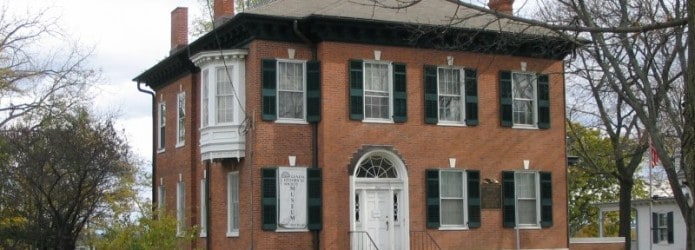
is into this bustling community, that Robert Balmanno (1780-1861)
arrived. Purchasing a lot on Seneca Lake in 1831, he is credited with
building a cottage in the Gothic Revival style, one of the earliest in Geneva
in this style. The “brick cottage residence and very beautiful garden” was
put up for sale in 1839, but it seems Balmanno retained ownership of the
property until 1850, when he sold it to John Remer. Five years later Remer
sold it to William and Sarah Herrick. The property remained in the Herrick
family through 1923, when it was sold to Gertrude Ranney Sholes. Sholes sold
it to Jane VerPlanck in 1926, who maintained ownership until the house was
sold to William and Blanchard Walker in July 1957. It is Blanchard Bartlett
Walker (1908-1997) who bequeathed the property to the Geneva Historical
Society in 1997.
|
|
Terraced Gardens
C
harles Williamson is credited with laying out
the properties and lots on South Main Street.
Natural terraces, probably
formed by the glaciers that carved out the lake, descended from the crest of a
long hill down to the lakeshore. The Annin survey, completed in 1793, laid
out Main Street on the crest of this hill. Williamson’s original plan placed
building lots on the west side of the street and designated the eastside lots
as lakeside gardens. Property owners on the west side would own land down to
the lake, but Williamson prohibited building on this land, hoping to preserve
the view. However, it was not many years before the increasing value of the
lakeside land led to the sale of the lots for building purposes. The
lakeshore and the terraced gardens then became exclusive to the property
owners on this side of South Main Street.
The 1850 advertisement for the sale of Balmanno Cottage describes the site as
including “...Garden of Fruit and Flowers...beautifully overlooking the Lake
and surrounding country with a Hanging Garden, on half a dozen Terraces, that
extends from Cottage door to the Beach.” References to other terraced gardens
along South Main Street indicate that they were a source of beauty and pride
among the residents. |
|
Balmanno Cottage: The Other Side of the Sixties
Upon
the death of Blanchard Bartlett Walker in 1997, Balmanno Cottage was
bequeathed to the Geneva Historical Society. In addition to the house and the
gardens, the collection of furnishings accumulated by her husband, Dr. William
Walker, was given to the Society. The furnishings are an outstanding example
of the antique collecting typical of many affluent Americans in the 1940s
through 1960s. Collectors like Dr. Walker were often influenced and inspired
by great collectors, such as Henry Francis DuPont and John Rockefeller. The
Walker collection reflects Americans’ drive in the 1950s to define their
culture; an urge that resulted in great interest in American history, folk
culture, and art. The collection includes a mixture of 18th and 19th
century pieces and consists of furniture made primarily in New York, New
England, and Philadelphia.
Blanchard Bartlett Walker (1908-1997) was the
daughter of the Reverend Murray Bartlett and Blanchard Howard. Her father
served as President of Geneva’s Hobart and William Smith Colleges from 1919
until his retirement in 1936, bringing Blanchard to Geneva for most of her
childhood. She attended private school in Baltimore and finishing school in
Europe. She secured a role in a Broadway production for a year, but a career
in acting eluded her and she took a job in the American Red Cross during World
War II, operating “rest and relaxation” hotels for Allied troops. She became
the manager of U.S. operations for the Irish company William Corelson & Sons
in 1950. She met Dr. William Walker, an orthopedic surgeon, and the two
married in March of 1957. The Walkers purchased the South Main Street property
the same year. Blanchard became a strong supporter of the Geneva community,
with a particular interest in Hobart and William Smith Colleges, St. Peter’s
Church, and the Geneva Historical Society.
The building is an
outstanding example of early Gothic Revival architecture in Geneva and
maintains the terraced garden lot that is a unique feature of the Seneca Lake
shoreline. The house remains much as it was upon Mrs. Walker’s death.
|
|
Balmanno Cottage is open Saturdays, 10am-4pm and Sundays, 1-5pm.
Please contact the Geneva Historical Society for more information.
583 South Main Street, Geneva, NY 14456
|