

John Johnston:
"The Father of Tile Drainage in the United States"
|
John Johnston was born in Knockknolling, Dalrys,
Dumfrieshire, Scotland, on April 11, 1791. He immigrated to the United States,
landing at New York City in April of
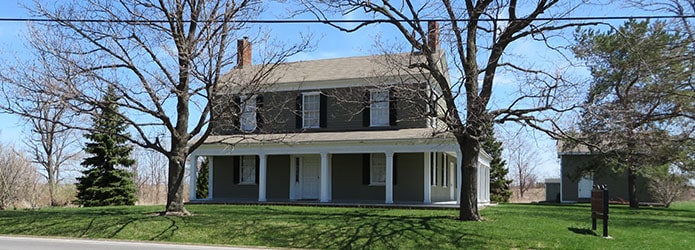
1821. The following year he purchased 112 acres of farmland in Seneca County
and built a house there, which he called “Viewfields”. Later he added several
more parcels to the farm, bringing the total size to 320 acres.
Due to abundant springs in the area, Johnston’s farm
retained a great deal of moisture, often imperceptible on the surface, but detrimental to crops.
Familiar with the use of tile drainage in Scotland, Johnston knew of its ability to increase the
yield of heavy, wet soils. He sent to Scotland for two pattern tiles in 1835, which he took to
Benjamin F. Whartenby, a crockmaker, in Waterloo, N.Y. Whartenby made 3,000 tiles that Johnston
laid down on his farm in 1838. The process was so successful that by the time he retired from
farming he had 72 miles of tile drains on his 320-acre farm. Whartenby continued making tiles,
producing 840,000 in 1849, and Waterloo was home to ten tile drainage factories by 1871.
A
prolific writer for newspapers and magazines, Johnston
promoted tile drainage at every opportunity, even traveling to advise other
farmers on the technology. Because of
his ceaseless advocacy he became known as “The Father of Tile Drainage” in the
United States. Johnston’s son-in-law
Robert Swan also adopted the technology for Rose Hill farm, helping to make it
the premier farm in the state in 1858. Johnston died November 24, 1880 in his ninetieth year, having changed
the course of agriculture in the United States.
|
|
Tile Drainage
|
The Mike Weaver Drain Tile Museum is comprised of a
collection of over 500 drain tiles ranging in date from 500 B.C. to plastic
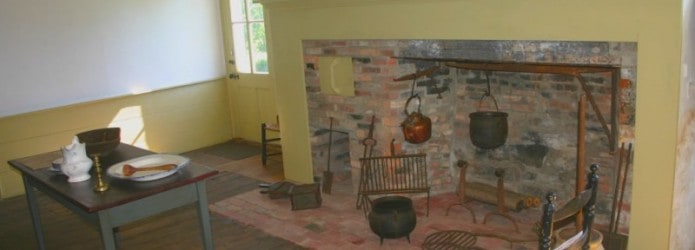
“tiles” of recent times. The museum is housed in the 1822 home of John Johnston,
a pioneer in tile drainage technology.
The Mike Weaver Drain Tile Museum at the John Johnston House
chronicles an important innovation in American agricultural development, the introduction of tile
drainage to American farming. By laying curved tiles or pipes just under
the soil’s surface, a farmer can drain excess water off of the land, thereby
increasing crop yields. This a technique which has existed for millennia, but which was not
widely used in the United States until John Johnston laid down tiles on his Seneca County
farmland in 1838.
The origin of tile drainage is
obscure. In 200 B.C. Cato described the use of brush, straw, poles, stones,
boards and tile to drain fields. Pliny in the first century A.D. suggested the
use of roof tiles in drainage. Eventually farmers realized that
curved drainage tiles were more effective than flat ones and used poles to form
horseshoe-shaped tiles. The tiles were handcrafted until the invention of the
extrusion machine in 1843 in England, which allowed the manufacture of tiles in
a myriad of shapes.
|
|
The Mike Weaver Drain Tile Collection
|
Marion "Mike" Weaver was an engineer in USDA Soil Conservation from 1936 to his
retirement in 1966. He then worked for 20 years as a consultant in drainage, irrigation, and dam building.
Weaver started his tile collection in 1950 when workers dug up an odd-looking tile during a project excavation
and gave it to him. The collection grew as other engineers learned of Weaver’s interest and began giving him tiles
to preserve. Eventually, the collection grew to over 500 pieces and in 1964 Weaver wrote and published the book,
History of Tile Drainage. In 1994 Mike Weaver gave his collection to the Geneva Historical Society in
recognition of the area’s connection to the development of this important technology.
The Weaver collection also includes letters, papers, pamphlets and books on tile drainage. These are available for
viewing at the Geneva Historical Society Archives. For more information, please call the Society at 315-789-5151.
Currently only a small portion of the Drain Tile Collection is on display in
the Johnston House. More of it will be displayed in the future.
|
The Johnston House is located east of Geneva, New York, between New York
State Thruway Exits 41 and 42. The house is on East Lake Road at
the junction of Route 96A, 1 ½ miles south of Routes 5 & 20.
The Johnston House is open for tours Saturdays, 10am-4pm and
Sundays, 1-5pm, May 1 to October 31 or upon request. Tours are one-half hour and
run on the hour and half hour. The last tour is one-half hour before closing.
|